
Precision steel fabrication Pakistan projects depend on is the difference between a frame that bolts up cleanly on site and one that needs re-drilling, shimming or cutting apart. For plant owners, contractors and machine builders, accuracy decides how fast equipment is installed, how long it runs without misalignment, and how much rework lands on the budget. This guide explains what precision steel fabrication involves, where tolerance is won or lost, and how to judge whether a workshop can deliver precision steel fabrication at the standard your project needs.
What Precision Steel Fabrication Pakistan Buyers Should Expect
Precision steel fabrication is the controlled cutting, forming, welding and assembly of steel components to defined dimensional limits, so parts fit each other and the surrounding structure without site corrections. The key word is controlled. Accuracy is not one machine or one skilled welder; it is a chain of steps in which every stage keeps the error small enough for the next stage to stay within tolerance.
For buyers in Pakistan, precision steel fabrication matters most where parts must meet other parts: machinery bases, process equipment skids, structural connections, brackets, guards, tooling and custom components that must mate with imported equipment. A loose fit costs time on site, and time on site is the most expensive time in any project.
A fabricator offering precision steel fabrication should be able to state the tolerances it works to for a given part, explain how they are checked and show where the checks are recorded.
What Fine Tolerance Engineering Means in Practice
Tolerance is the permitted variation from a stated dimension. A hole position limit, a flatness limit across a base plate and a squareness limit on a frame are all tolerances. Fine tolerance engineering starts when the drawing defines which dimensions are critical and which are not.
Not everything needs the tightest limit. Applying tight tolerances to every dimension raises cost without improving function. Good precision steel fabrication separates the dimensions that govern fit and alignment, such as bearing seats, mounting faces and bolt patterns, from general dimensions that can follow standard limits such as those in ISO 2768. Agreeing this split at the quotation stage prevents disputes later and keeps pricing honest. Tolerance is only one of several cost drivers, which are broken down in steel fabrication project costing in Pakistan.
CNC Steel Cutting Accuracy
Cutting sets the starting accuracy of every part. CNC plasma, laser, oxy-fuel and waterjet systems cut from digital nesting files, which removes the manual marking errors that build up on hand-laid plates. Each process has its own capability: laser generally holds tighter edge quality on thinner plate, while plasma and oxy-fuel suit thicker sections where edge squareness and heat-affected zones need managing. Thermal cut quality is commonly judged against ISO 9013.
CNC steel cutting accuracy also depends on things the machine cannot fix alone: plate flatness, kerf compensation, stable calibration and consumables in good condition. Worn nozzles and electrodes widen the cut and tilt the edge. In precision steel fabrication, cut parts are checked against the drawing before they move to forming, because a part that starts wrong cannot be corrected later without cost. Parts that need exact profiles and clean edges are best specified with dedicated precision parts cutting services in mind.
High Precision Metal Shaping
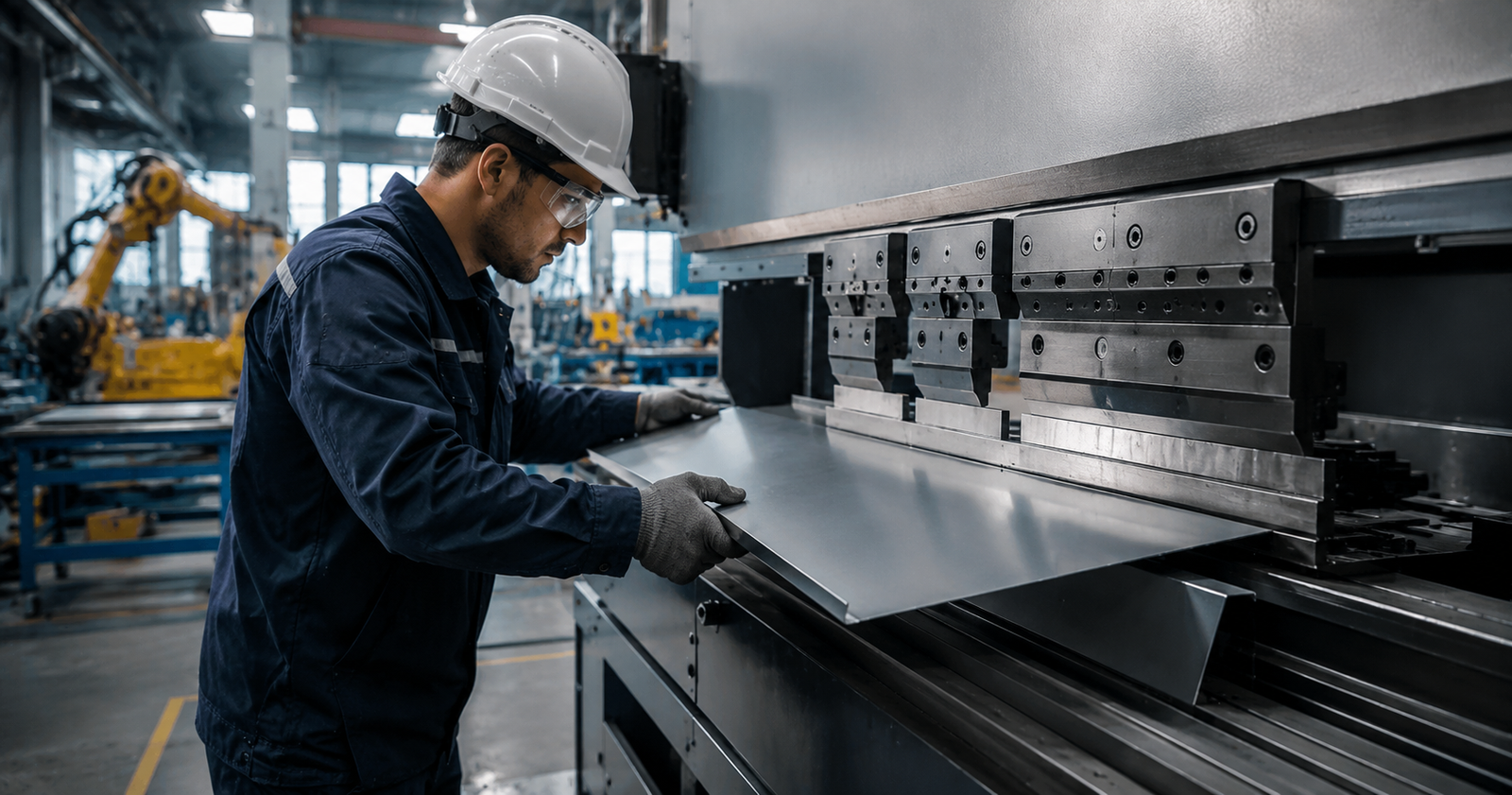
Bending, rolling and forming change the geometry of steel and introduce springback, the tendency of the metal to partly return after bending. Press brake work with correct tooling, accurate back-gauge setting and a bend allowance calculated for the grade and thickness keeps flanges and angles consistent from the first part to the fiftieth.
Plate rolling and section bending call for trial pieces and template checks, because thickness and yield strength vary between batches. Fabricators who record the setup for each job can repeat it, which is how high precision metal shaping stays consistent across repeat orders instead of depending on one operator’s memory. This repeatability is a core part of precision steel fabrication.
Calibrated Welding Execution and Distortion Control
Welding is where precision is most often lost. Heat shrinks steel as it cools, and an unplanned weld sequence can pull a straight frame out of square. Precision welding systems manage this through fixtures that hold parts in position, balanced weld sequences, controlled heat input and, where needed, stress relief or post-weld machining of critical faces.
Calibrated welding execution also means equipment is maintained and parameters are controlled. Welding procedure specifications, qualified welders and recorded parameters under industrial welding standards such as AWS D1.1 or ISO 3834 give buyers evidence that welds are made the same way each time. A workshop that claims precision steel fabrication but cannot show its welding procedures or welder qualifications is asking the buyer to take accuracy on trust.
Exact Measurement Assemblies and Inspection
You cannot control what you do not measure. Exact measurement assemblies rely on calibrated instruments such as verniers, micrometers, height gauges and levels, and for larger work laser or total-station measurement, all with current calibration records. Assemblies are built on flat, level surfaces or in jigs, and critical dimensions are checked before and after welding, not only at final inspection.
Trial fitting of large components in the workshop is one of the most valuable habits in precision steel fabrication. It exposes fit-up problems while they can still be fixed with a grinder, rather than on site with a crane waiting.
Detailed Fabrication Control in Precision Steel Fabrication
Detailed fabrication control turns individual skills into repeatable quality. It includes material traceability to mill certificates, marked parts, controlled drawing revisions, inspection checkpoints and a written record of non-conformances and how they were closed.
For buyers, this documentation answers a simple question: if a part is wrong, can the workshop find out why? A fabricator with strong control can trace the plate, the cutting program, the welder and the inspection result for any component. That traceability separates real precision steel fabrication from work that is merely neat.
Where Precision Steel Fabrication Matters Most
Precision steel fabrication pays back most in these applications:
- Machinery frames, bases and skids where motors, gearboxes and pumps need aligned mounting faces
- Structural connections and base plates where anchor bolt patterns must match concrete already poured
- Process equipment, ducting and supports that must connect to existing lines
- Custom components that replace imported parts
- Repeat production runs where every unit must be interchangeable
Where equipment is sourced from several countries, a fabricator able to work from foreign drawings and unit systems, and to flag drawing conflicts before cutting, saves real time. This is a practical advantage of precision steel fabrication in Pakistan for projects tied to imported machinery. Our guide to industrial fabrication services in Pakistan covers how this factory-grade work is organised more broadly.
How to Evaluate a Precision Steel Fabrication Partner in Pakistan
Before awarding work ask these questions and read what to check before you hire a steel fabrication workshop alongside them:
- Which tolerances can you hold on this part, and how will you verify them?
- What cutting technology do you use, and how is it calibrated?
- Are welding procedures and welder qualifications documented?
- Do you trial-fit large items before dispatch?
- How are materials traced and inspection records kept?
- Can you show similar completed work and its inspection reports?
A confident workshop answers these directly. Vague answers on tolerance are the clearest warning sign when choosing precision steel fabrication support.
Start Your Precision Steel Fabrication Pakistan Project
For precision steel fabrication Pakistan projects that need verified accuracy, share your drawings critical dimensions and inspection requirements with BG Engineering and Fabrication in Karachi so tolerances, process and checks are agreed before cutting begins.