
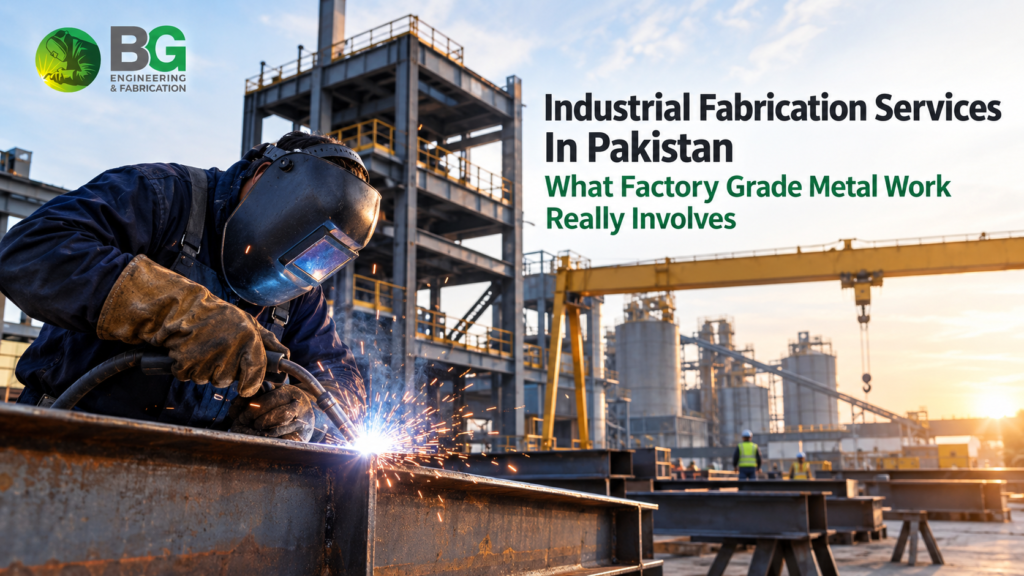
If you have ever watched a cement plant, a power station, or a large textile mill running through the night, you have seen the result of good fabrication. Every frame, platform, silo, and machine base in those facilities started as raw steel and became a working part of the plant through careful engineering.
This guide explains how industrial fabrication services in Pakistan work, what separates factory-grade metal work from ordinary workshop jobs, and what to look for when choosing a partner for your next project.
What Are Industrial Fabrication Services?
Industrial fabrication services are the cutting, forming, welding, machining, assembly, and finishing of steel and other metals into structures and equipment for industrial use. Typical outputs include structural frames, pressure vessels, storage tanks, conveyors, hoppers, and heavy machine bases.
What makes them industrial is the standard of accountability work that follows approved drawings, uses certified materials, and passes documented inspections. These are industrial engineering solutions, not just welded metal.
How Is Industrial Fabrication Different from a Regular Workshop?
Industrial fabrication differs from general workshop welding in four ways:
- Scale: larger, heavier assemblies and higher volumes.
- Tolerance: tighter dimensional accuracy, because parts must fit on site without rework.
- Certification: qualified welders and approved welding procedures.
- Documentation: material certificates, inspection reports, and traceability.
A local workshop can repair a gate or build a small stand. A large scale fabrication unit is set up to deliver hundreds of tonnes of structural steel or a precision-built process vessel, on schedule and to code.
What Does Large-Scale Fabrication Unit Actually Mean?
The phrase is often used loosely, so it helps to know what to check. A genuine large-scale facility usually has:
- Covered production area and overhead cranes that handle heavy plates and long sections.
- CNC cutting equipment (plasma, oxy-fuel, or laser) for accurate plate profiles.
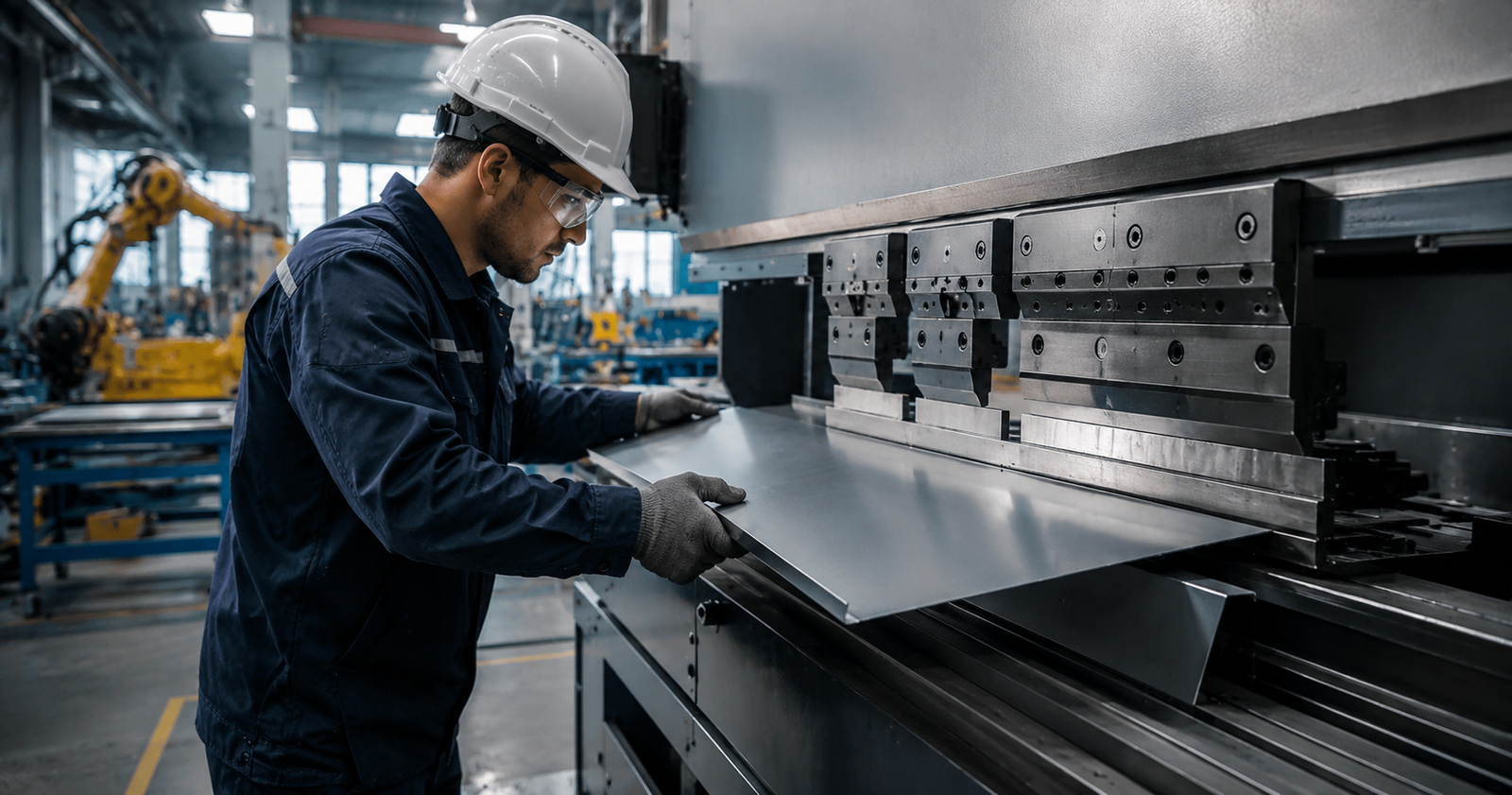
- Plate rolling and press brake machines for thick material.
- Multiple welding processes operated by qualified welders.
- Blasting and coating facilities for surface protection.
The more of these a fabricator has in-house, the less time your project loses to outsourcing and coordination.
Heavy Duty Steel Production Why Material And Preparation Matter
Heavy-duty steel production deals with thick plate, large sections, and high-strength grades that must survive vibration, heat, impact, and abrasion. Getting the material right is only half the job. Factory-grade steel processing covers the preparation that follows:
- Material verification: checking mill test certificates against the specified grade, such as ASTM A36 or EN S355.
- Cutting and beveling: shaping edges so weld joints can achieve full penetration.
- Forming and straightening: bending and aligning without adding hidden stress.
- Surface preparation: abrasive blasting to a defined cleanliness before coating.
Most premature failures in the field trace back to weak preparation, not weak steel. Careful processing is what makes a component last a decade instead of a few seasons.
The Engineered Manufacturing Workflow Step by Step
A reliable engineered manufacturing workflow takes a project from idea to delivery in a controlled sequence:
- Requirement review: scope, loads, applicable codes, and deadlines are agreed.
- Design and detailing: fabrication drawings, bills of materials, and weld maps are approved.
- Material control: every plate and section is tagged and linked to its certificate.
- Fabrication and assembly: work follows planned stations with checks along the way.
- Inspection and testing: dimensional checks, visual weld inspection, and non-destructive testing (ultrasonic, magnetic particle, or dye penetrant) where required.
- Surface treatment: painting, coating, or galvanizing suited to the site environment.
- Documentation and dispatch: a data book of certificates and reports ships with the product.
This is what makes quality repeatable. The last unit in an order should match the first.
High-Capacity Fabrication Lines and Production Engineering Systems
Once a fabricator moves beyond one-off jobs, it needs high-capacity fabrication lines. These arrange cutting, fit-up, welding, and finishing in a logical flow so parts move through the plant without bottlenecks.
Behind the lines sit production engineering systems scheduling, jigs and fixtures, welding procedure control, and inventory tracking. For a buyer, they translate into three benefits:
- Consistency: because fixtures keep repeated parts in tolerance.
- Speed: because parallel stations shorten lead times.
- Predictability: because planned flow supports reliable delivery dates.
Together they enable industrial scale metal production for both multi-unit orders and single heavy assemblies.
Which Industries Depend on Heavy Industry Fabrication in Pakistan?
Heavy industry fabrication supports any sector where equipment cannot afford to stop:
- Cement, sugar, and fertilizer plants: structures, silos, chutes and platforms.
- Textile and manufacturing units: machine frames and material-handling systems.
- Power and energy: boiler supports ducting, and structural frames.
- Oil, gas, and petrochemical: tanks, pipe racks, skids, and vessels.
- Infrastructure and warehousing: steel buildings, bridges, and mezzanines.
Local conditions matter too. Coastal humidity in Karachi and dust and heat in inland regions call for different coating systems and material choices, which is why regional experience counts.
How to Choose a Fabrication Partner You Can Trust
Fabrication mistakes are expensive, so ask for evidence, not promises. Look for:
- Experience: Completed industrial projects with clear scope, size, and sector.
- Expertise: Engineers and certified welders working to codes such as AWS D1.1 or ISO 3834.
- Authority: Quality certification such as ISO 9001 and verifiable client references.
- Transparency: Clear quotations, defined inspection points, material traceability, and written warranty terms.
About BG Engineering and Fabrication
Founded in 2018, BG Engineering and Fabrication is a Karachi-based fabrication and engineering company. Our team handles laser cutting, bending, welding, punching, and complete fabrication in carbon steel, mild steel, cold roll coil, and stainless steel, with cutting thickness up to 15 mm / 25 mm.
Recent work includes: glass bridges, rooftop structures and pergolas, laser-cut main gates, staircase and balcony railings, false ceilings, and decorative wall panels. Featured projects:
Workshop: Plot No. 7/146, Street No. 9, Siraj ud-Daulah Road, Delhi Mercantile Society, Karachi 74800 | +92 335 3755075 info@bgeng.pk
Before signing, ask these questions:
- What is the largest assembly you can build in-house?
- Which welding codes and inspection methods do you follow?
- Will I receive certificates and a full documentation package?
- What is your on-time delivery record on similar projects?
Clear, specific answers signal real industrial capability.
Final Thoughts
Good industrial fabrication comes from three things working together: capacity, process control, and proven expertise. When you evaluate suppliers look past the equipment list and ask how they verify materials control welding, and document quality. The answers will tell you whether a partner can deliver factory-grade results.
Planning a project? Contact our engineering team for a technical consultation or a facility visit.