
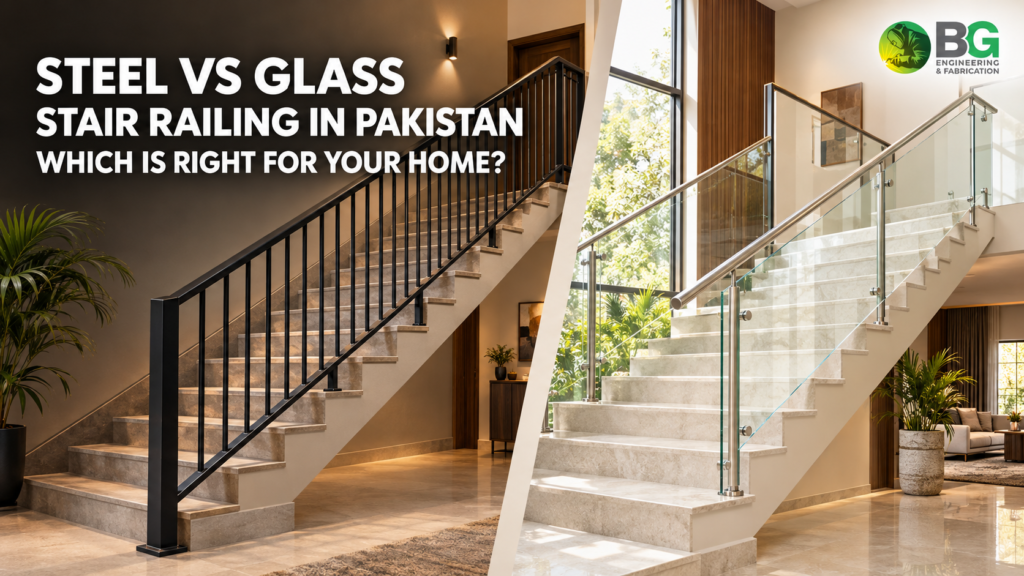
Steel vs glass stair railing in Pakistan is not only a style choice. For most homes, the right railing depends on three things: where the staircase is (indoor or exposed), how close you are to the coast, and how much maintenance you will realistically do.
Steel here covers both mild steel (MS) and stainless steel. Mild steel is the most economical but needs a protective finish. Stainless steel resists corrosion better, and grade 316 is generally preferred near the sea. Glass gives an open look, but its safety depends heavily on glass type and fixing.
This guide compares all three so you can avoid rust, wobble, and safety problems before you place an order.
Start with Location, Not Style
Most people choose a design first and a material second. Reverse it.
| Location | Main concern | Material direction |
| Indoor staircase | Appearance, safety, easy cleaning | Any of the three; choose on design and budget |
| Terrace, balcony, exterior stair | Rain, sun, corrosion, thermal movement | Stainless steel or well-protected steel; glass with careful fixing |
| Coastal areas such as Karachi | Humidity and salt in the air | Corrosion resistance and a proper finish matter most |
| Public or commercial building | Load, code, durability | Engineered design with documented fixing |
For exposed areas, also see our page on terrace and balcony railings.
Mild Steel (MS) Railings
Strengths: economical, strong, easy to shape, and well suited to ornamental and custom patterns.
Limits: it rusts if the coating is damaged. In humid or coastal conditions, an average paint job fails sooner than most owners expect.
What decides quality:
- Surface preparation before painting, with rust and mill scale removed
- Primer plus topcoat, powder coating, or galvanizing where suitable
- Welds ground smooth and fully coated, since weld joints are where rust usually starts
- Closed tube ends so water does not collect inside
MS works well for indoor stairs and sheltered areas. For exposed locations, the finishing system matters more than the steel itself.
Stainless Steel Railings
Strengths: corrosion resistance, low maintenance, and a clean modern look.
Grades matter. Grade 304 performs well in most indoor and mild outdoor conditions. Grade 316 contains molybdenum and handles chloride (salt) exposure better, so it is usually the safer choice near the sea. Stainless is not “rust-proof”: poor finishing, contamination from carbon steel tools, or harsh cleaning chemicals can still cause surface staining.
What to ask for:
- The stainless grade confirmed in writing, and a mill certificate on larger projects
- Welds cleaned and polished after welding, and passivated where appropriate
- A consistent finish (brushed or mirror) across handrail and posts
Glass Railings
Strengths: open and bright, and it can make a small staircase feel larger.
Limits: fingerprints and water marks, regular cleaning, and a safety level that depends on glass type and fixing.
Key points:
- Use tempered or laminated tempered glass. Laminated glass holds together if it cracks, which is why it is commonly preferred on stairs and open edges.
- Thickness should not be guessed. It depends on the system (post-and-clamp, standoff, or channel) and the span, so it should be specified for your layout.
- Edges should be polished, and glass should never rest directly on metal. Proper gaskets or packers are used.
- On exposed terraces, check how the system handles drainage and movement.
Glass is not a replacement for steel. It is normally held by steel or stainless fittings, so the real decision is between a glass-panel system and an all-metal balustrade.
Steel vs Glass Stair Railing in Pakistan Side-by-Side Comparison
choose stainless steel (316 near the coast) for exposed stairs and terraces, mild steel with a proper finish for sheltered indoor stairs on a budget, and glass for indoor or protected stairs where openness matters.
| Factor | Mild steel | Stainless steel | Glass (with steel or SS fittings) |
| Upfront cost | Usually lowest | Usually higher | Varies widely by system |
| Corrosion resistance | Depends on coating | Good (316 better in coastal air) | Depends on the metal fittings |
| Maintenance | Repaint over time | Occasional cleaning | Frequent cleaning |
| Design flexibility | Very high | High | Modern, minimal |
| Best for | Indoor, sheltered, custom patterns | Exposed and coastal areas | Indoor feature stairs, protected terraces |
Prices change with design, length, finish, and market rates, so a reliable quote needs measurements. Our steel fabrication project costing FAQ explains how fabrication quotes are built.
Safety Basics Before You Approve a Design
Local building rules and your architect’s drawings always come first. As general reference, many residential guidelines internationally use these ideas:
- Guard height on open sides is typically around 900 mm to 1,000 mm.
- Stair handrail height is commonly roughly 860 mm to 960 mm, and the rail should be comfortable to grip continuously.
- Gaps between balusters are usually limited so a small child cannot pass through, commonly about 100 mm.
- Climbability: horizontal rails and ladder-like patterns can let children climb, which matters in homes with young kids.
- Load: the railing and its fixings must resist pushing and leaning forces, not just look solid.
These are general reference points, not a substitute for your local requirements or an engineer’s approval.
Fixing Is Where Railings Fail
A good railing with weak fixing still wobbles. Check these:
- Base plates or core-fixing into sound concrete, with proper anchors rather than loose plugs
- Post spacing suited to the span and load
- Waterproofing at terrace and balcony posts, so water does not enter the concrete and corrode the anchor
- Alignment on the slope: the handrail should follow the staircase line without kinks at landings
If the stairs are still being designed, plan the railing at the same stage to avoid awkward post positions later. See our pages on stair design and staircases.
Maintenance by Material
- Mild steel: Inspect once a year, touch up chips quickly, and repaint before rust spreads.
- Stainless steel: Wipe with mild soap and water, avoid chlorine-based and abrasive cleaners, and rinse after cleaning.
- Glass: Use a non-abrasive glass cleaner and check clamps and gaskets periodically for looseness.
Common Mistakes
| Mistake | Result |
| Choosing a style before deciding the location | Material fails in exposed areas |
| Unfinished welds or open tube ends | Rust starts at joints and inside tubes |
| Using carbon steel tools on stainless | Surface contamination and staining |
| Ordering glass without confirming the fixing system | Guesswork on glass thickness and spacing |
| Ignoring child-safety gaps | Safety risk and a failed inspection |
| Installing before floor finishing is complete | Damaged railing or misaligned bases |
What to Prepare Before Asking for a Quote
- Staircase length, rise, and landing dimensions, or a clear photo with measurements
- Indoor or exterior location
- Preferred material and finish, or a request for options
- Handrail type: round, flat, or wood-capped
- Whether children or elderly family members use the stairs daily
- Timeline, and whether floor finishing is complete
Working with BG Engineering and Fabrication
BG Engineering and Fabrication, based in Karachi, offers stair railing and staircase railing designs as part of its fabrication services. A practical first step is a site-based scope review of your measurements, location, and safety needs, so material and fixing are chosen together.
Share your details through the contact page. For fabrication background, read fabrication material selection and industrial welding standards in Pakistan.